
BY PAUL WAATTI, DIRECTOR OF INDUSTRY ANALYSIS
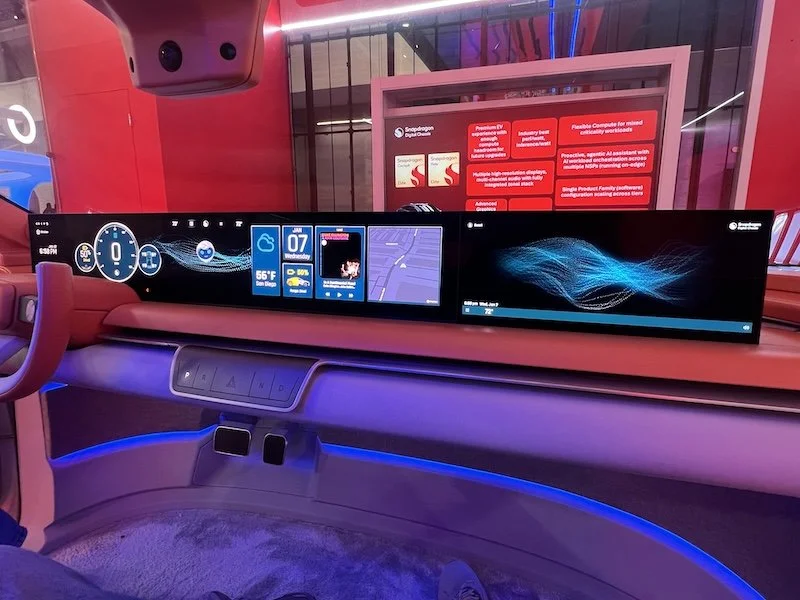
CES 2026 didn’t feel like a traditional auto show, and unlike recent years, vehicle launches weren’t a priority. Instead, the focus shifted toward signaling long-term direction, mostly through supplier partnerships rather than new sheetmetal. The only automakers with a meaningful footprint on the show floor were Sony Honda Mobility’s Afeela, and Chinese brands, Geely (Zeekr, Lynk & Co, Geely) and Great Wall Motors, with visibility that was impossible to ignore. In the absence of other OEM stands, Chinese automakers leaned in, broadcasting brand messaging and framing how they think about technology, speed, and scale. More than symbolism, it reflected a growing confidence in software-first, vertically integrated development as a competitive advantage, not a future ambition.
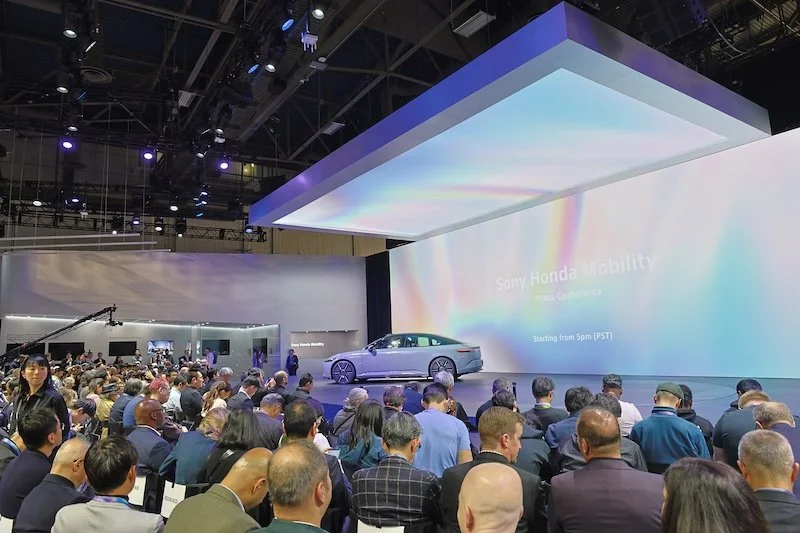
CES 2026 reflected that SDVs and AI are not part of the future automotive landscape, but are here and already transforming automotive.
This year’s show reinforced just how quickly software-defined vehicles and AI are becoming ubiquitous in the automotive world, with these transitions already embedded in OEM product roadmaps. What’s changed even more is the tone of the conversation. The emphasis has shifted to execution strategy and to managing the transition without blowing up cost structures, development timelines, or organizational complexity. Increasingly, suppliers are setting the pace, and CES emphasized this with a spotlight on architecture and ecosystems rather than individual vehicle showcases.
That framing matters when looking at Qualcomm’s growing automotive presence, which stood out as pragmatic and timely. Rather than leaning only into distant autonomy narratives or abstract AI concepts, Qualcomm focused on how things actually work in today's production vehicles. The emphasis was on convergence, and that cockpit systems, driver assistance, connectivity, and AI workloads can coexist on shared compute platforms without forcing OEMs into all-or-nothing architectural bets. The message was (refreshingly) less about where the industry might be in a decade, and more about what can realistically ship over the next product cycle.
That message came through most clearly during a live ride demo in a Lincoln Aviator equipped with Qualcomm’s Snapdragon Ride Flex platform. The system simultaneously managed Level 2 highway assistance, driver monitoring, high-fidelity 3D navigation, media playback, and AI-driven voice interaction, without noticeable lag or awkward prioritization between safety-critical and non-safety functions. The user interface didn’t feel constrained when ADAS was active, and the driving system didn’t behave as if it were isolated from the rest of the vehicle. From the passenger seat, there wasn’t a single feature that took priority. The takeaway wasn’t extreme performance. It was how unremarkable and seamless the coexistence felt in real driving — and that, in this case, was the point.
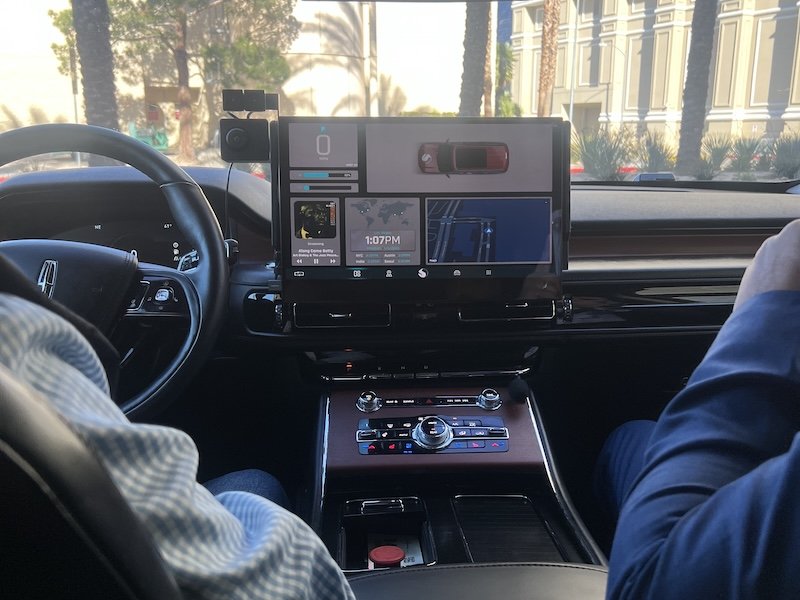
Qualcomm’s demonstration of its Snapdragon Ride Flex platform, featuring ADAS, cockpit, and semi-autonomous drive capabilities on a single SoC, showed how much advanced and intelligent capability is possible in such a cost-effective platform.
Just as important was what wasn’t in the vehicle. The sensor suite was intentionally mainstream and cost-conscious, consisting of a single forward camera, radar, and a driver-monitoring system. No lidar. No excessive redundancy. No sense that the demo depended on premium-only hardware to function. Qualcomm’s approach is that this configuration could be scaled up or down depending on the vehicle’s positioning, supporting entry-level ADAS, premium hands-free systems, or more advanced luxury applications. That adaptability positions Qualcomm’s strategy to have significant volume potential that spans price bands and global portfolios.
In automotive terms, that’s a meaningful shift. For years, the default response to complexity was separation — dedicated ECUs for ADAS, infotainment, clusters, and body functions, all validated independently and stitched together late in the process. That approach drove cost, wiring mass, and integration risk. Qualcomm’s demo instead showed how a practical, scalable configuration behaves when multiple workloads share compute resources, without compromising safety or responsiveness.
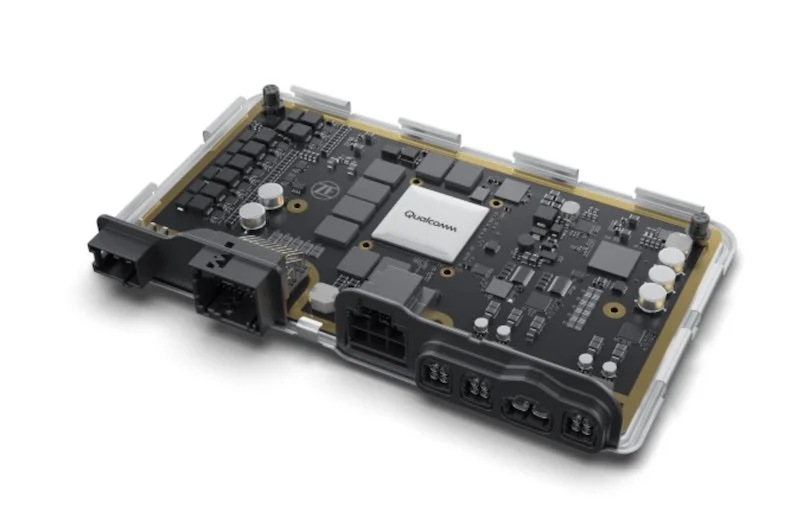
Partnerships with suppliers (like this ZF partnership for a scalable ADAS and autonomous drive platform) helps get innovation into the market faster.
This simplification-as-a-competitive-advantage theme ran through Qualcomm’s broader CES messaging. Partnerships with suppliers like ZF highlighted faster deployment paths. Central compute concepts with OEM partners emphasized consolidation without forcing a single software identity or brand experience. The throughline was flexibility, through a platform and technology suite designed to meet OEMs where they are today, while supporting continuous, incremental improvement and deliberate scaling across vehicle segments and price points.
Crucially, none of this is theoretical anymore. Qualcomm pointed to real-world deployments and co-development programs already moving in this direction. Its work with BMW on the upcoming iX3 reflects a full-stack approach spanning ADAS, driver monitoring, and software integration that leverages shared data across domains. Similar principles are evident in Qualcomm-enabled programs like Afeela 1 — the only press conference at the show directly related to a production vehicle — and in Chinese OEMs like LeapMotor, where centralized compute consolidates multiple vehicle domains under shared architectures. These are production strategies in play (or soon to be) rather than a future aspiration.
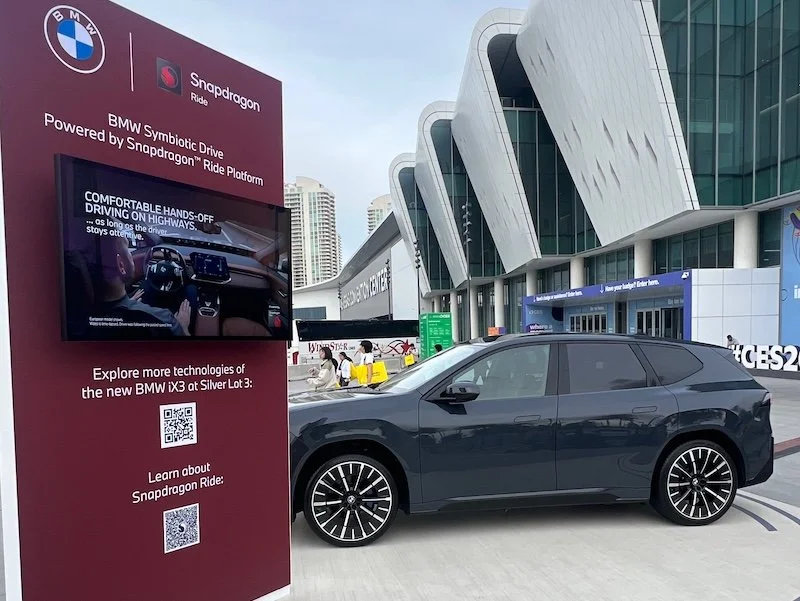
Much of the innovation behind all-new BMW iX3 is powered by Qualcomm’s Snapdragon Ride Platform.
CES also underscored how OEMs themselves are pushing toward centralized compute as a strategic imperative. Trailing similar announcements from GM and Rivian in late 2025, Ford highlighted its own in-house development of a centralized vehicle compute platform, positioning software and system architecture as core competencies rather than outsourced functions. While distinct from supplier-led platforms, Ford’s approach reinforces the same underlying reality that software-centric vehicles will increasingly be built on fewer, more capable compute foundations, with OEMs and suppliers arriving at similar architectural conclusions from different starting points.
The show also helped frame the contrast between leading compute platform providers, such as Qualcomm and NVIDIA. NVIDIA remains a dominant force in the high-end of automotive compute, with a focus on physical AI, large-scale simulation, and comprehensive autonomy development. That strength is particularly visible in autonomous mobility deployments such as the Zeekr–Waymo robotaxi platform, where AI systems trained and validated in real-world environments are beginning to move from proof-of-concept into early commercialization, albeit within constrained geographies and operating domains.
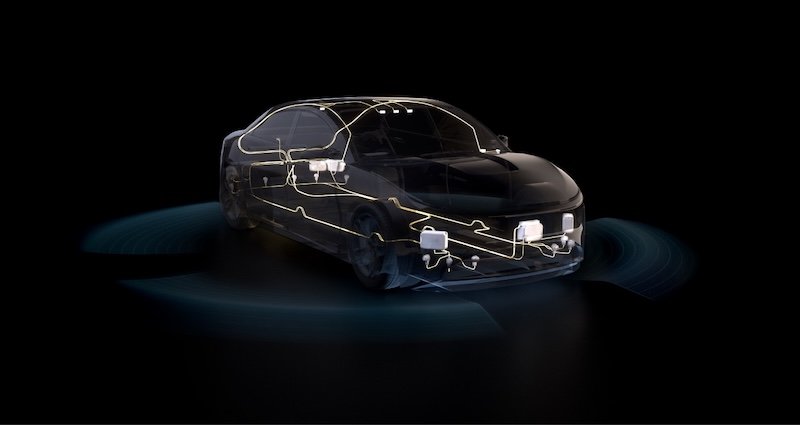
NVIDIA’s Drive Hyperion Ecosystem enables various levels of autonomous driving, with a new focus on autonomous robotaxis.
Qualcomm’s aim is broader and deeper — focused on mass-volume penetration across global vehicle portfolios spanning the range from affordable entry level to high-end bleeding edge. That divide is already visible in the numbers: Qualcomm’s automotive business now generates roughly twice the revenue of NVIDIA’s and is hovering above $1 billion per quarter, reflecting its sheer scale rather than concentrated, high-end programs. In today’s margin-constrained environment, owning the floor through reach and execution increasingly matters more than defining the ceiling.
Other players reinforced fragmentation. Mobileye emphasized scaling hands-free, eyes-on ADAS through tightly integrated systems designed for mass adoption. MediaTek leaned into cockpit compute and immersive in-car entertainment, underscoring how competitive the cabin experience has become. Valeo showcased its expanding role as a system-level Tier-1, demonstrating integrated sensor fusion, in-cabin perception, and software within a broader SDV ecosystem that bridges safety, UX, and regulatory needs. Bosch, meanwhile, focused on extending AI into existing vehicle architectures, acknowledging that many automakers need evolutionary upgrades to current and next-generation ICE and hybrid platforms rather than a clean-sheet reinvention. The industry isn’t converging on a single solution — it’s splitting along lines of deployment speed, cost tolerance, and architectural aim. Crucially, amid all this fragmentation, Qualcomm’s demos were among the most comprehensive and tangible in the automotive section of CES. While others showed off new hardware, software, and AI applications, Qualcomm’s display pulled it all together, showing how it integrates it all into the modern automobile.

The show’s tone marked a subtle but important shift in automotive storytelling. The EV narrative faded into the background, and autonomy rhetoric became more measured. The spotlight moved toward deployable ADAS, practical in-vehicle AI, and platforms that can be sustained and improved over a vehicle’s lifecycle. The strong presence of Chinese OEMs reinforced the urgency that speed, vertical integration, and platform reuse are no longer optional advantages — they’re competitive requirements.
CES 2026 ultimately showed that the industry’s challenge is not ambition, but execution. And Qualcomm has new and innovative executions, as evidenced by Qualcomm’s Flex SoC demo, which wasn’t about what might be possible someday. It showed what’s ready from Qualcomm today, and Flex is already appearing in production models. A mainstream sensor suite. Shared compute. Mixed-criticality workloads. A platform that scales from entry-level vehicles to luxury applications without constant reinvention. The next phase of competition at the OEM and supplier level will be decided by who can deliver real-world solutions at cost, at scale, and now – and Qualcomm is enabling the ecosystem to make that a reality.