
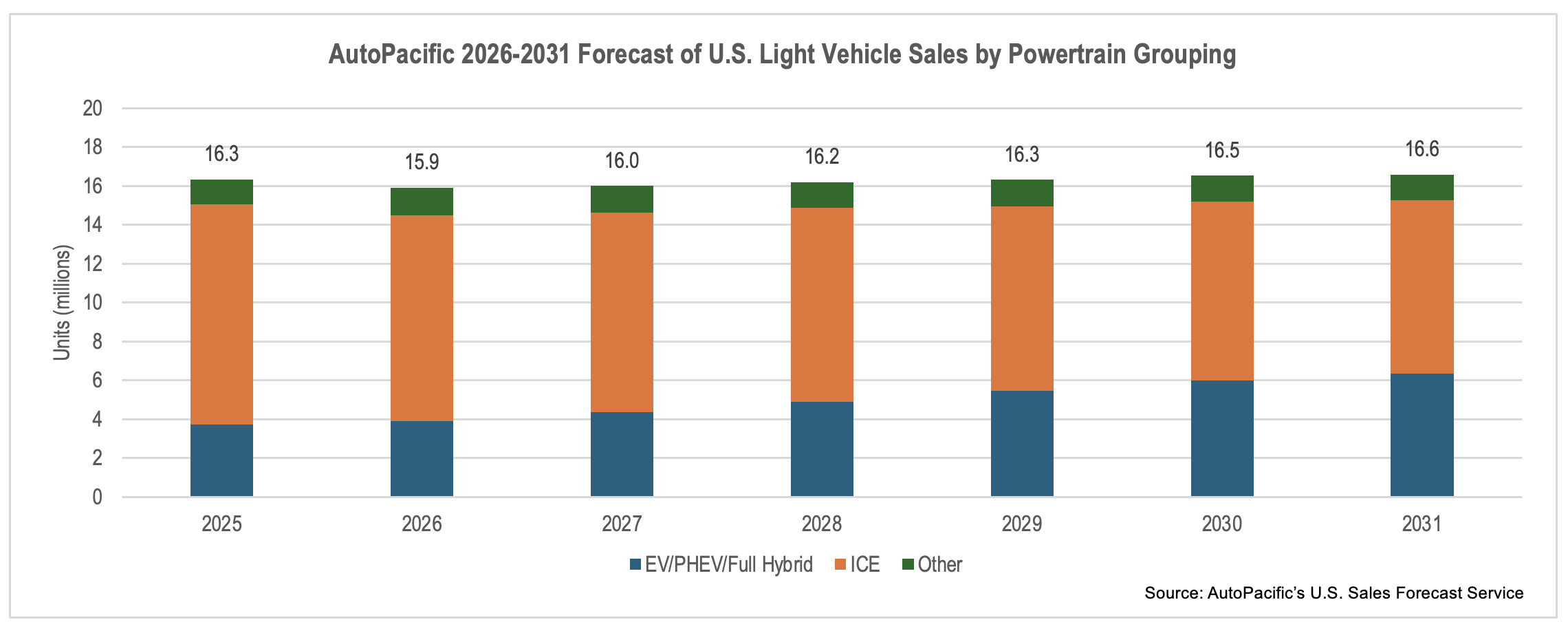
Noted automotive market research and consulting firm AutoPacific recently issued its forecast of annual U.S. light vehicle sales, predicting a 15.9 million unit year in 2026, down from 16.3 million units sold in 2025. Following this projected drop, AutoPacific expects volume recovery through the remainder of the decade and into the next. A primary focus for AutoPacific, and an important factor for industry growth, is alternative powertrains, specifically hybrids, plug-in hybrids (PHEV and EREV) and full electric vehicles (EV). As a whole, these alternative powertrains are expected to continue gaining market share throughout the forecast period, rising from 24% of the total market in 2025 to 38% in 2031, with hybrids powering most of that growth.
According to data from AutoPacific’s annual Future Vehicle Planner, comprised of nearly 18,000 consumers who intend to acquire a new vehicle within the next 3 years, demand for hybrids has ranged from 16% to 19% since 2022, while demand for EVs and PHEVs has dropped recently, influenced heavily by the elimination of Federal tax credits for EVs that have effectively made EVs a lot more expensive today, and compounded by tariffs, inflation, and continued concerns about EV charging. Regardless of shifts in interest, 36% of new vehicle shoppers intend some type of alternative powertrain, nearing AutoPacific’s 2031 market share expectation. “Whether it’s an EV, hybrid or PHEV, consumers continue to be more accepting of powertrains with some type of electrification for various reasons, including more available vehicles, better fuel economy, environmental concerns, attractive EV styling, or available features and technologies” says AutoPacific Director of Marketing and Consumer Insights Deborah Grieb.
EV Sales Drop but Republican Shoppers May Throw a Lifeline
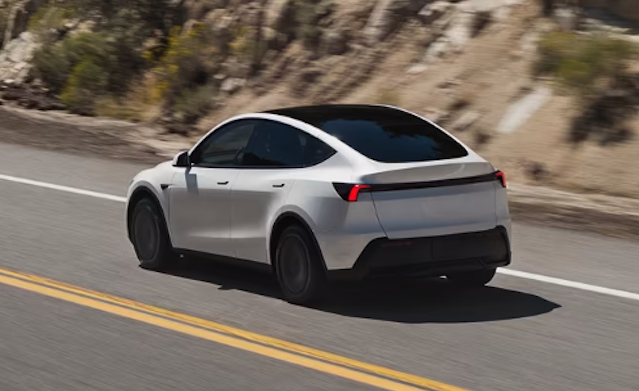
As expected after the elimination of Federal tax credits on EV purchases and the addition of tariffs on imported vehicles and parts, EV sales have dropped drastically since October 2025. AutoPacific is forecasting an EV market share dip to 7% in 2026, marking the very first expected annual drop in EV market share since 2011, when the first mass produced EVs went on sale. While these new Republican policies have dealt a major blow to EV adoption in the U.S., Republicans may be a lifeline for EV growth going forward. Data from the latest Future Vehicle Planner reveal that EV intenders are now more likely to be Republican than Democrat. Specifically, 43% of EV intenders are Republican while 36% are Democrats – a story that has everything to do with Tesla, whose controversial leader Elon Musk has earned strong support from many Republicans. While Tesla did experience sales and market share declines in 2025, it must be noted that Tesla still accounted for 44% of all U.S. EV sales in 2025. Given Tesla’s dominance over the EV market and Elon Musk’s popularity with Republicans (which has led to 48% Tesla considers being Republican and only 32% of them being Democrat – a virtual swap from the prior year), it’s logical that EV consideration in general among Republicans has skyrocketed.
With Tesla’s continued dominance in the EV space, it may be that Republican shoppers end up being a lifeline for EVs in the U.S. market, at least in the short term. And contrary to popular perception, politics – outside of support for Elon Musk – don’t seem to play much into Republican shoppers’ attitudes towards EVs. AutoPacific’s data show that among Republicans who do NOT want an EV, only 13% say political beliefs are a reason they don’t want them. Rather, cost and charging/range anxiety - the usual EV rejection reasons – are the top the reasons for EV rejection among Republicans. Beyond the short-term lifeline that may be attributed to Republicans, the U.S. market may be starting to evolve to where EVs really are just powertrain options rather than statement pieces.
Chinese EVs are Coming to North America – What Does That Mean for the U.S. EV market?
Due to recent negotiations between China and Canada, the U.S.’ neighbor to the north will get Chinese EVs in the near future. As data from AutoPacific’s Future Vehicle Planner show considerable and surprising awareness and interest in Chinese vehicles among U.S. new vehicle shoppers, this development suggests that Canada - a market that is culturally not too different from the U.S. in many ways - will be a good proxy for how Americans will respond to the eventual entry of Chinese vehicles in the U.S. market. Additionally, AutoPacific’s soon-to-be-fielded Canada Future Attribute Demand Study will provide the ability to compare the U.S. and Canada market for Chinese auto brand considerations and concerns, EV interest and feature demand.
Certainly, many Chinese vehicles, and EVs in particular, demonstrate impressive performance, technology, AI integration, self-drive features, and designs that are getting a lot of attention thanks to American consumers’ social media exposure. While Chinese EVs are not yet depicted in AutoPacific’s forecast, it is safe to say they will make a very significant impact in the U.S. marketplace when they arrive. Automakers competing in the U.S. market need to be more than aware of the volume and market share threat they potentially pose; they need to be proactive now to meet that challenge head-on when they arrive.
About AutoPacific’s U.S. Sales Forecast Service
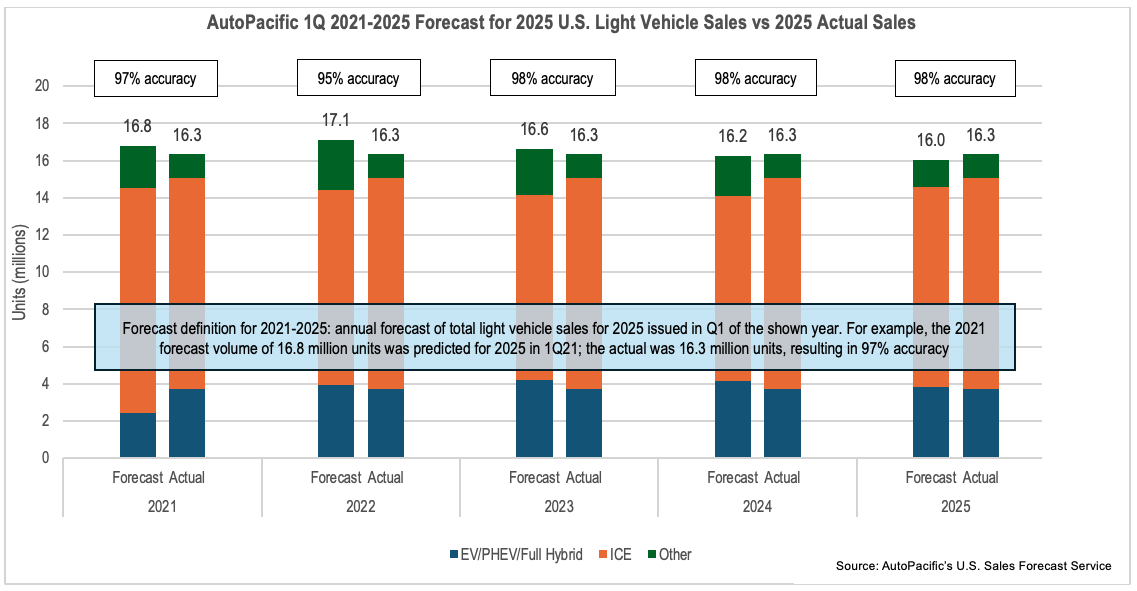
For forty years, AutoPacific’s U.S. Sales Forecast Service has proven to be a reliable and accurate source for sales volumes with 98% accuracy for 2025 measured from Q1 2025 to end of year actuals and 97% 5-year accuracy measured from Q1 2021 to end of year actuals. “Anything can happen to severely change the path of predicted volumes, but our unique forecast methodology not only incorporates our strong understanding of the auto market, products, regulatory issues, and manufacturing and distribution, but our own syndicated research, allowing direct voice of the consumer input regarding brand, segment, and powertrain demand to factor into the forecast as well, contributing to our excellent forecasting accuracy,” says AutoPacific President and Chief Analyst Ed Kim.
About AutoPacific
AutoPacific is a future-oriented automotive marketing research and product consulting firm providing clients with industry intelligence and sales forecasting. The firm, founded in 1986, also conducts extensive proprietary and syndicated research and consulting for auto manufacturers, distributors, marketers, and suppliers worldwide, including its highly recognized Future Attribute Demand Study (FADS). The company is headquartered in Long Beach, California with affiliate offices in Michigan, Wisconsin, and the Carolinas. Additional information can be found at http://www.autopacific.com.