

BY: ED KIM, PRESIDENT AND CHIEF ANALYST
Earlier this month, Qualcomm and Wayve, a UK-based company developing a universal AI-powered software stack for consumer vehicles and robotaxis, announced a very noteworthy collaboration that has the potential to democratize autonomous drive technology sooner than later. Ultimately, the results of this collaboration will also help power Qualcomm’s strategy to scale to the Level 4 robotaxi space.

Qualcomm is seeing considerable success with its Snapdragon Ride platform, which is notable for serving as a central processor that has a foundation of a modular and flexible architecture that integrates ADAS and autonomous drive components from any number of third-party suppliers. As automakers have a large number of ADAS and autonomous hardware suppliers to choose from, Snapdragon Ride has allowed automakers to seamlessly integrate scalable hardware and software architectures addressing respective tiers of functionality into their vehicles using Snapdragon Ride’s SoCs and the Active Safety software stack. In other words, Snapdragon Ride is a very flexible full stack solution that allows fast and cost effective integration into vehicles, as opposed to point solutions that are piecemeal, take longer to develop, and are potentially more expensive.
Wayve’s AI Driver aims to provide automakers with a universal and cost-effective autonomous drive solution that uses AI to understand the local environment rather than relying heavily on HD maps. The collaboration between the two companies will apply the AI Driver as an available intelligence layer to Snapdragon Ride, resulting in an all-in-one advanced ADAS and autonomous drive platform with safety at the core. The all-in-one nature of this collaboration should result in faster and easier integration into vehicles - crucial in a rapidly evolving market environment for ADAS and autonomous drive features.
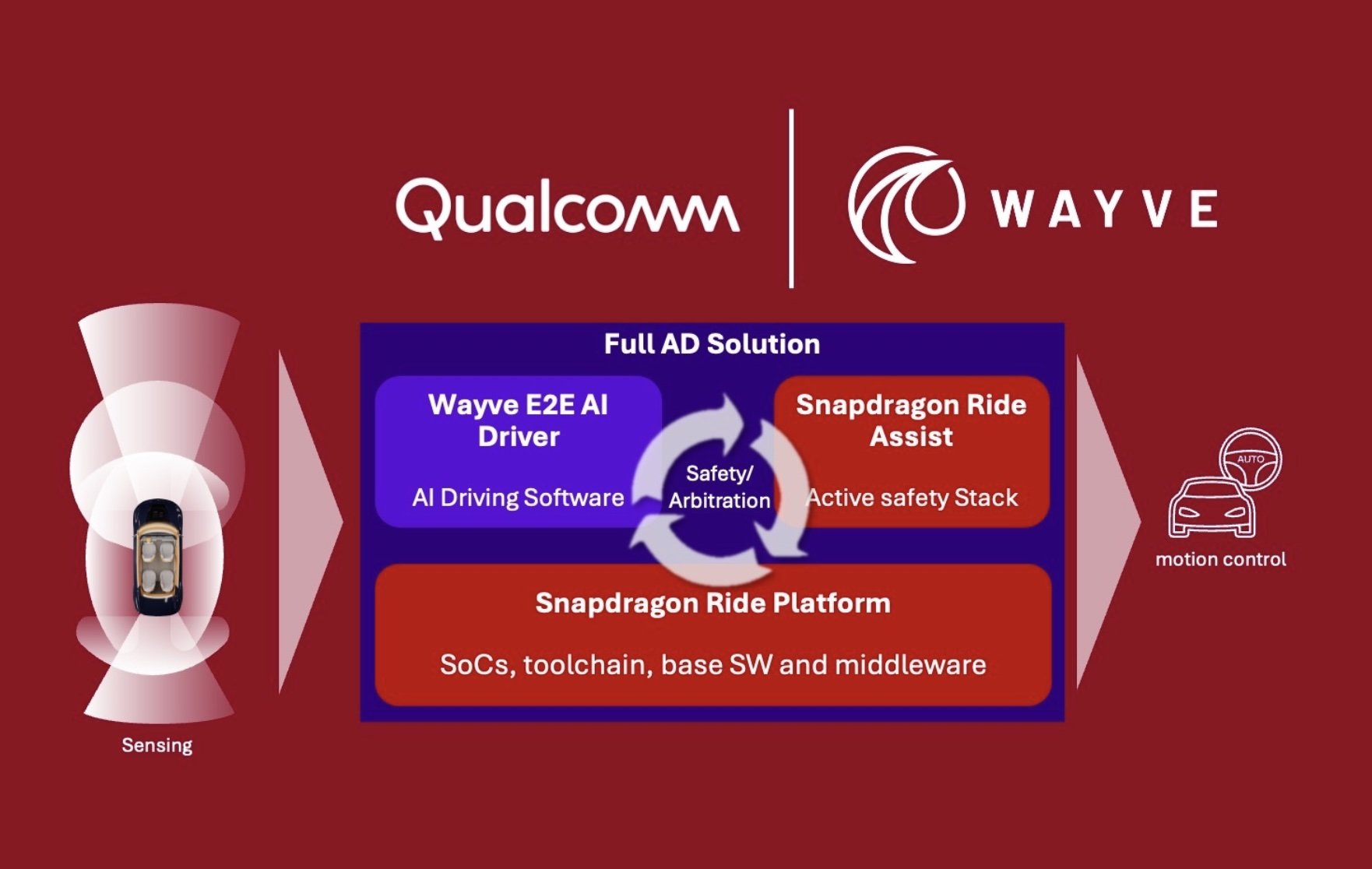
Additionally, these efforts will also benefit Qualcomm as it gears up to provide efficient hardware and brainpower for Level 4 robotaxi efforts. Nvidia has been a notable force in the burgeoning robotaxi space, utilizing big compute engines and sensors to ensure safe and reliable operation on public roads. In fact, Nvidia has become such a big name in the robotaxi and autonomous drive technology spaces that it has led to some perceptions in the industry that Nvidia is a more premium player than Qualcomm.
This isn’t entirely accurate. While Nvidia rightfully touts their work in fully automated Level 4 and Level 5 driving, Qualcomm and Nvidia have fundamentally different automotive business approaches. While Nvidia is very focused on ADAS and autonomous drive solutions that use a lot of compute with the assumption of them trickling down into more affordable and mainstream applications, Qualcomm has an arguably stronger focus on the market and automakers’ current ADAS and hands-off/eyes-on Level 2+ driver assist needs today through Snapdragon Ride Pilot full stack solution, which boasts right-sized compute efficiency and power management and is scalable from the most basic low-cost ADAS implementations to fully autonomous ones, with the latter to be enabled by its collaboration with Wayve. Put simply, both companies are competing for the same business, but Qualcomm’s approach is more all-encompassing in regards to where regulations and the market are today.
Both approaches are crucially important in today’s rapidly changing automotive landscape, and in many ways these two computing giants don’t just compete with each other, but also complement each other as each has unique areas of focus. And certainly, Qualcomm’s approach has led to great success in terms of reach, having shipped over 350 million SoCs in total, including over 75 million AI-powered infotainment SoCs and over one million Snapdragon Ride ADAS SoCs so far.

Their revenue and growth is healthy too, with Qualcomm’s automotive business having achieved $4 billion in revenue in FY25 and over $45 billion in confirmed future OEM business in the pipeline. As Anshuman Saxena, Qualcomm’s VP of Automated Driving and Robotics Business, noted in an interview for this story, “Now my competitors would say…bring Level 4 robotaxi tech to (retail) passenger vehicles. That approach makes sense. But from an automaker perspective, you have to take care of 80-90% of the volume (which isn’t Level 4) as well, right?”
With Snapdragon Ride soon able to deliver fully autonomous driving via its collaboration with Wayve, Qualcomm’s capabilities in advanced L4 autonomy are set to grow as well, ensuring continued revenue growth and innovation. This will be critical for Qualcomm. While its automotive revenues today exceed Nvidia’s, through its focus on serving OEMs’ current and near-term needs, Snapdragon Ride’s ability to accommodate future L4 autonomy will be critical, particularly in the face of Nvidia’s strong progress in that space. Fortunately, Snapdragon Ride’s inherent flexibility and its ability to accommodate the future market’s L4 needs ensures that Qualcomm will remain a major force in the future of automotive in the face of its competition.