
As Chinese EVs Prepare to Launch in Canada, AutoPacific Study Reveals Strong Canadian Interest
A recent survey of Canadian new vehicle shoppers reveals strong acceptance of Chinese brand vehicles for quality and price reasons. Using a modified version of its benchmark Future Attribute Demand Study (FADS), AutoPacific surveyed more than 1,800 Canadian residents who intend to acquire a new vehicle within the next three years. “While Chinese EVs are effectively banned in the U.S. due to trade barriers, Canadian consumers are about to be able to access them starting later this year. As Canada is a North American market with many cultural similarities to the U.S., we saw an opportunity to use Canadian consumers as a proxy for U.S. consumers when Chinese EVs eventually become available to them,” says Ed Kim, president and chief analyst at AutoPacific.
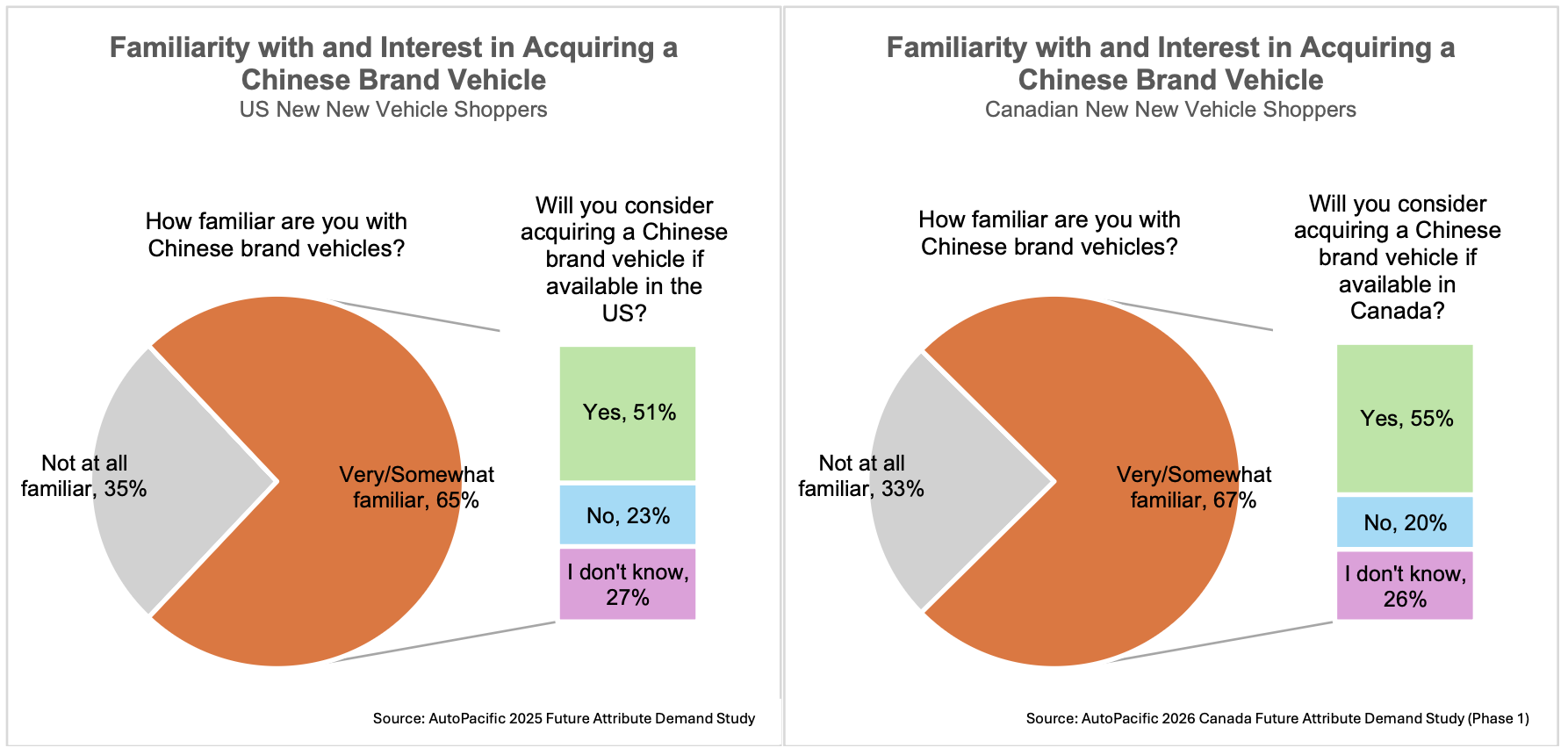
Chinese vehicles have gained significant attention from the automotive community in recent months, but study data show knowledge is also high in the general public. In June 2025, AutoPacific’s US FADS revealed 65% of new vehicle shoppers are very or somewhat familiar with Chinese auto brands and 51% would consider acquiring a vehicle from a Chinese brand if available in the U.S. Comparatively, in April 2026, AutoPacific’s Canada FADS revealed 67% of Canadian new vehicle shoppers are very or somewhat familiar with Chinese auto brands and 55% will consider acquiring one if available in Canada. Both groups of intenders say Facebook and Instagram are sources of knowledge about Chinese auto brands, as well as auto shows and automotive enthusiast/news sites.
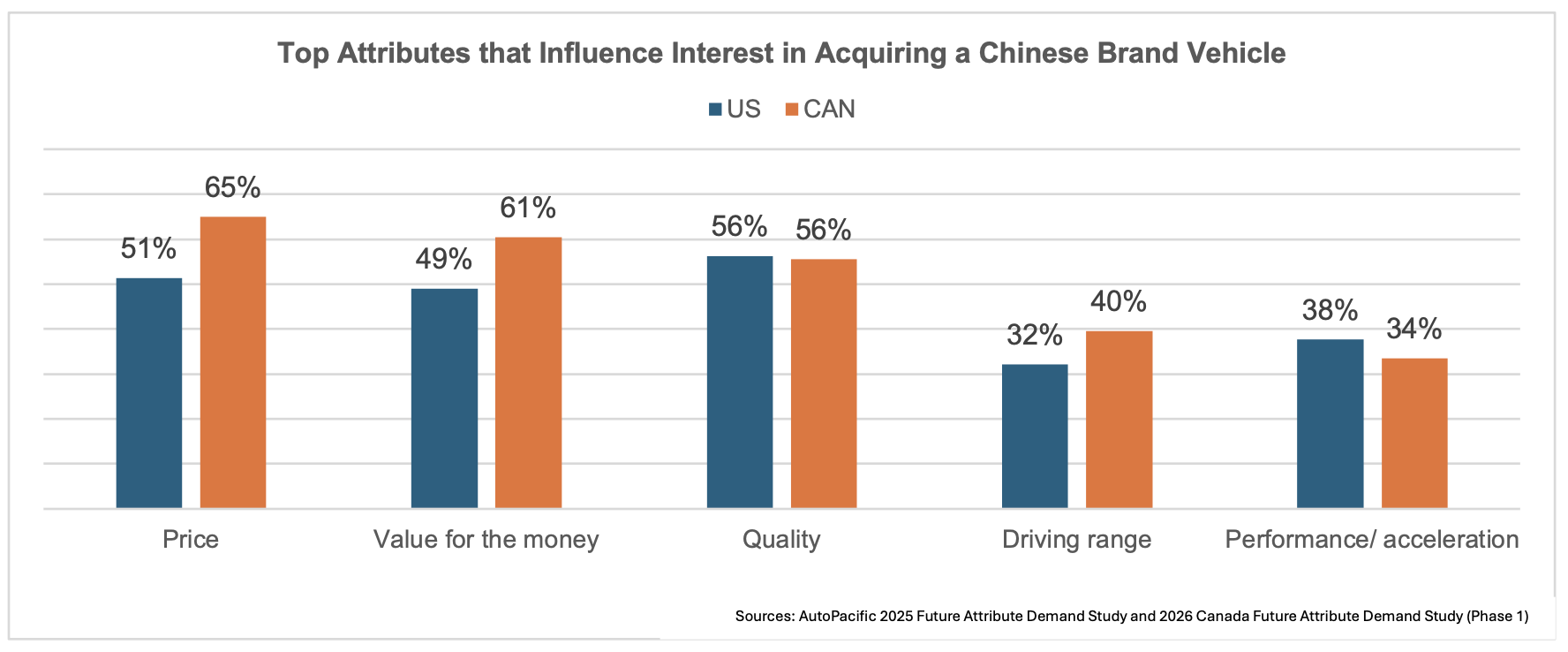
What is influencing interest? Price, quality and value for the money. While low price and strong value have been touted in Western media as Chinese vehicle strengths, this is largely due to the weak Chinese Yuan (CNY) relative to both the U.S. Dollar (USD) and Canadian Dollar (CAD). Actual retail prices of Chinese EVs in Canada have yet to be seen, but the Canadian consumer clearly sees price and value as a big reason to go Chinese. It is, however, very unlikely that actual retail prices of Canadian-market Chinese EVs will be priced anywhere near as low as they are in China. Chinese brands will need to ensure their pricing strategies appeal to their Canadian target customers’ strong demand for low price and strong value.
Ranking 3rd with both US and Canadian new vehicle shoppers, quality is a top influencer for those who will consider acquiring a Chinese brand vehicle. While study data show that new vehicle shoppers who say they’ll consider a Chinese brand vehicle are younger than the overall sample, with a median age of 36 for the US and 41 for Canada, compared to a total sample median age of 39 for the US and 46 for Canada, data reveal that older respondents are more likely to be influenced by quality. “Quality as a top future purchase influencer conveys the importance of Chinese vehicles meeting expectations, but also that younger consumers may be more tolerant of lesser quality if the price is right,” says Deborah Grieb, AutoPacific director of marketing and consumer insights.
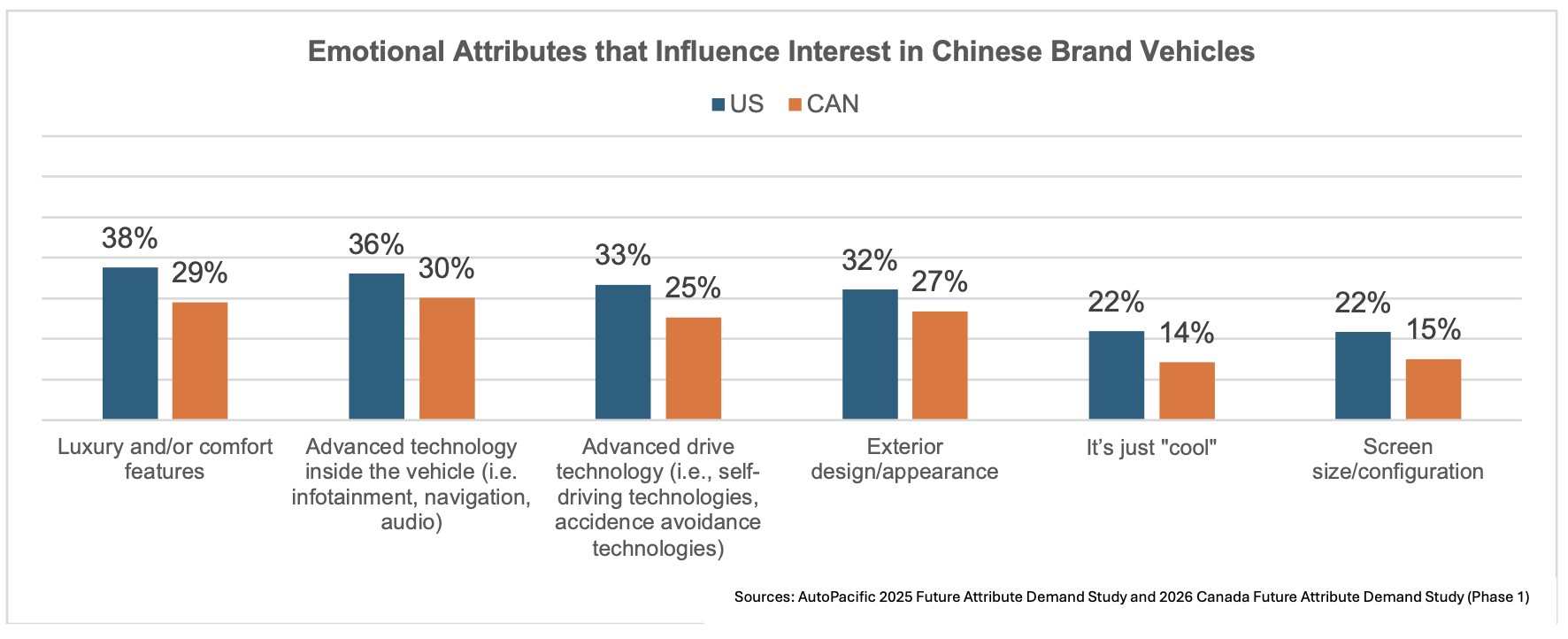
Interestingly, Canadian consumers are less likely to be influenced than U.S. consumers by more emotional aspects of many Chinese vehicles such exterior design (-6%-points), advanced technology in the vehicle (-6%-points), advanced driver assistance/autonomy (-8%-points), and luxury/comfort features (-9%-points). The potentially pragmatic aspects of Chinese EVs are much more of a draw for Canadian shoppers than style and technology.
Regardless of whether it’s a Chinese brand EV or a brand from another origin, Canadian respondents are 6%pts more likely to consider an EV for their next new vehicle than US respondents and 5%pts more likely to intend to acquire one.
From the survey, AutoPacific also gained insight into the types of vehicles Canadian shoppers are considering, powertrain intention, brand consideration, their views of vehicles and driving, and interest in over 160 features and technologies. “With Canada getting Chinese brand vehicles soon, we wanted to get a gauge on acceptance and concerns, but also better understand what Canadian shoppers are looking for in their next new vehicle, Chinese or otherwise,” notes Grieb.