
Automotive Wasn’t the Headline at Qualcomm’s Investor Day 2026, But the Growth Signals Were Hard to Ignore
By Paul Waatti, Director of Industry Analysis
While the topics of AI and data centers drew much of the spotlight at Qualcomm’s Investor Day 2026, automotive quietly continued strengthening the company’s case to investors that its long-term growth is no longer tied primarily to smartphones.
Qualcomm is steadily building a more diversified business spanning AI, edge computing, automotive, industrial IoT, and connected devices. These other business areas may have generated the biggest headlines, but automotive offers a different type of opportunity: long product cycles, platform-based revenue, and growing exposure at the heart of the industry’s transition toward software-defined vehicles.
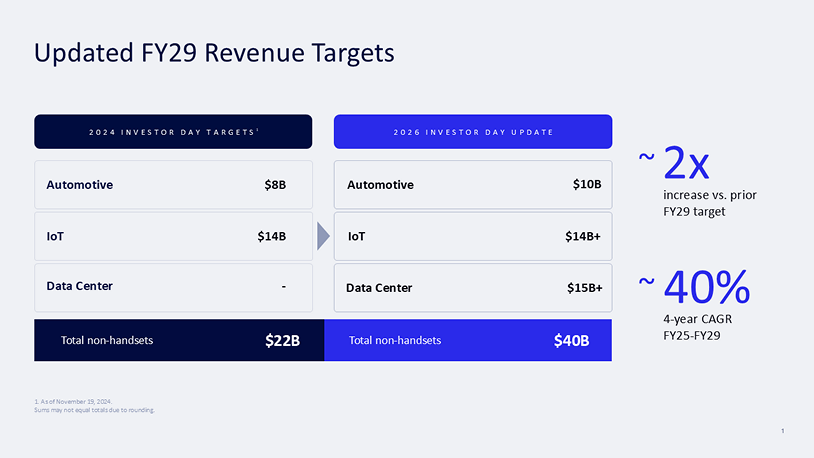
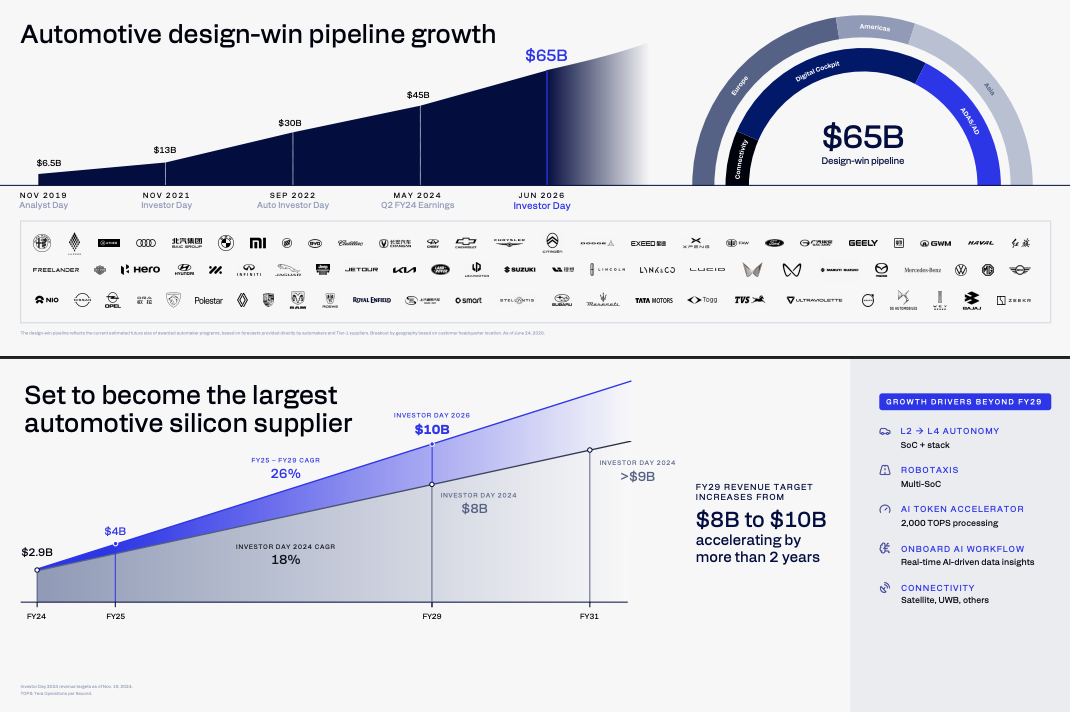
The latest figures reinforced that argument. Qualcomm expanded its automotive design-win pipeline to $65 billion and raised its fiscal 2029 automotive revenue target to $10 billion, up from the prior $8 billion target announced at its 2024 Investor Day.
Automotive is becoming a much larger contributor to Qualcomm’s broader objective of reaching $40 billion in non-handset QCT revenue by fiscal 2029, when handsets are expected to account for roughly one-third of QCT revenue.
The automotive business already has momentum. Qualcomm reported record QCT automotive revenue of approximately $1.3 billion in the second quarter of fiscal 2026, up 38% year over year. That puts the business at meaningful scale before the full impact of newer cockpit, ADAS, connectivity, and centralized compute flows into future vehicle programs.
Perhaps the strongest auto takeaway from Investor Day is that Qualcomm is pushing to become a deeper technology layer inside the vehicle. The company’s automotive strategy is no longer limited to infotainment or telematics.
Through Snapdragon Digital Chassis, Qualcomm is targeting a broader share of the vehicle electronics stack, including digital cockpit, connectivity, advanced driver assistance and centralized compute.
Automakers are simultaneously simplifying vehicle electronics while adding more software-driven functionality. The industry is moving away from dozens of distributed electronic control units toward centralized vehicle architectures, creating an opportunity for suppliers capable of delivering scalable compute platforms spanning multiple vehicle domains. Qualcomm intends to be the go-to supplier.
Recent partnerships reinforce that strategy. Stellantis expanded its relationship with Qualcomm to deploy Snapdragon Digital Chassis technologies across cockpit, connectivity and ADAS functions within its next-generation vehicle architectures, integrated through STLA Brain.
More importantly, it demonstrates Qualcomm winning architecture-level roles rather than supplying isolated components.
The Bosch relationship adds another layer. Bosch and Qualcomm have already scaled cockpit computers together, with Bosch reporting more than 10 million cockpit computers delivered using Snapdragon Cockpit Platforms. The companies are now expanding into ADAS programs with Snapdragon Ride, including multiple design wins in East Asia and the first production vehicles expected in 2028.
Wayve offers a distinct path to automated driving. The companies are developing a pre-integrated ADAS and automated driving solution that combines Wayve’s AI Driver software with Snapdragon Ride and Qualcomm’s active safety software.
It does not make Qualcomm an autonomous-driving company on its own, but it does position Snapdragon Ride as a flexible compute platform that supports multiple software approaches.
The company’s strategy is not to own every layer of the automotive software stack. Instead, Qualcomm aims to provide the compute, connectivity and AI-capable foundation that automakers, Tier 1 suppliers and software partners can build upon.
That role could prove broader and more durable than supplying individual features, particularly as more OEMs consolidate cockpit, ADAS and connectivity onto shared computing platforms.
AI is an important part of that strategy, but it should not be overstated. Qualcomm’s broader Investor Day message focused on AI spanning the connected edge and data center.
In automotive, AI supports greater onboard computing capability, richer cockpit experiences, more advanced driver assistance and increasingly software-defined vehicles. The near-term opportunity is less about fully autonomous driving and more about expanding content per vehicle as automakers add digital services, connected features and advanced safety technologies.
The opportunity is substantial, but it is not without risk. A $65 billion design-win pipeline is not the same as recognized revenue. Vehicle programs can shift, launch timing can slip, production volumes can change, and automakers may adjust sourcing strategies as software-defined vehicle plans evolve.
Qualcomm also faces intense competition from Nvidia, Mobileye, traditional Tier 1 suppliers, in-house OEM software organizations, and regional technology companies, particularly in China.
Qualcomm’s automotive position looks considerably stronger than it did only a few years ago. The company has established meaningful scale in cockpit systems, is gaining traction in ADAS, has deepened relationships with major OEMs and Tier 1 suppliers, and is increasingly participating in centralized vehicle compute architectures.
Investor Day did not introduce a breakthrough automotive announcement, but it reinforced something arguably more important: automotive is becoming one of the clearest indicators that Qualcomm’s strategy to diversify beyond smartphones is taking hold. As vehicles become more connected, more software-defined, and more compute-intensive, Qualcomm’s role within the vehicle appears well-positioned to grow alongside them.